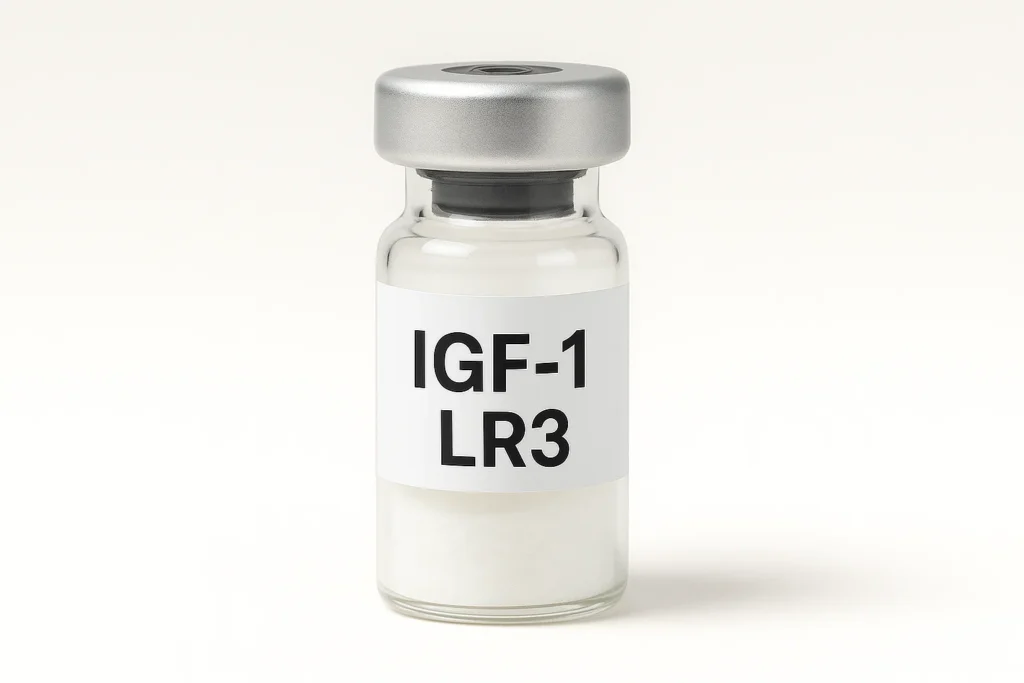
What is IGF-1 LR3
IGF-1 LR3 is a laboratory-engineered analog of insulin-like growth factor-1 (IGF-1). Its full name, insulin-like growth factor-1 long arginine 3, reflects two key modifications: an extended 13-amino-acid N-terminal sequence and the substitution of glutamic acid at position 3 with arginine. These alterations change how the molecule interacts with IGF binding proteins in controlled research environments.
Scientific studies demonstrate that these structural differences reduce IGF-1 LR3’s affinity for IGF binding proteins compared with native IGF-1, which can influence its stability and duration of activity in vitro and in certain preclinical models. Observations regarding prolonged half-life or altered signaling behavior are based solely on experimental research conditions and do not imply any suitability for clinical, therapeutic, or other biological use outside of properly regulated scientific investigation.
IGF-1 LR3 Structure
Sequence:
MFPAMPLSSL FVNGPRTLCG AELVDALQFV CGDRGFYFNK PTGYGSSSRR APQTGIVDEC CFRSCDLRRL EMYCAPL KPA KSA
Molecular Formula:
C₄₀₀H₆₂₅N₁₁₁O₁₁₅S₉
Molecular Weight:
9117.5 g/mol
CAS Number:
946870-92-4
All information above refers solely to the structural and chemical characteristics of the compound as reported in scientific and technical literature. These details are provided for laboratory reference and analytical research purposes only.
IGF-1 LR3 Research
Cell Division
In controlled laboratory and preclinical research environments, IGF-1 LR3 has been examined for its involvement in cellular growth and division pathways. As a modified analogue of native insulin-like growth factor-1 (IGF-1), the molecule has been studied for how it interacts with receptors and intracellular signaling networks linked to proliferation and maturation processes in various cell types, including those found in connective tissues and organ systems.
Research indicates that the structural differences in IGF-1 LR3 – particularly its reduced affinity for IGF-binding proteins – allow it to remain stable for longer periods in vitro compared to native IGF-1. This extended persistence has enabled researchers to investigate how prolonged receptor engagement may influence cellular activation patterns. Scientific literature notes that IGF-1 LR3 and related IGF-1 analogues may support fundamental processes such as cell-cycle progression and differentiation in test environments. These observations are limited to non-clinical settings and do not imply practical outcomes in biological systems outside of controlled research conditions.
Fat Metabolism and Glucose-Related Pathways
Preclinical studies exploring IGF-1 LR3 have investigated how the molecule interacts with signaling pathways associated with nutrient management, including those related to lipid turnover and glucose utilization. In experimental systems, IGF-1 LR3 has been shown to engage both the IGF-1 receptor and receptors involved in metabolic regulation, allowing researchers to evaluate how these interactions influence cellular uptake mechanisms and downstream biochemical responses.
These investigations suggest that IGF-1 LR3 may modulate pathways affecting lipid storage and mobilization in cultured cells, as well as influence glucose-dependent signaling cascades. Such findings provide insight into how IGF-related peptides may contribute to energy-management processes at a cellular level under laboratory conditions. These observations remain confined to in-vitro and animal-model studies and should not be interpreted as evidence of metabolic benefits, clinical effects, or suitability for any real-world use.
Myostatin-Related Pathways
Preclinical research has also examined IGF-1 LR3 in the context of myostatin, a regulatory protein known to influence muscle development pathways. Studies in laboratory models have explored how IGF-related peptides may interact with signaling mechanisms that modulate the activity of myostatin or myostatin-associated pathways.
These investigations typically focus on molecular interactions, gene-expression responses, and cellular adaptations observed under tightly controlled research conditions. Findings vary depending on model type and experimental methodology, and they remain limited to early-stage scientific inquiry. Any observed changes in myostatin signaling within these studies do not indicate practical or physiological outcomes beyond the laboratory and do not imply suitability for clinical, therapeutic, or performance-related applications.
IGF-1 LR3 Longevity Research
In controlled laboratory and preclinical research settings, IGF-1 LR3 has been examined for its involvement in cellular pathways associated with tissue maintenance, repair processes, and age-related biological mechanisms. Studies in various animal models have explored how IGF-related signaling may influence factors such as cellular turnover, metabolic regulation, and stress-response systems. These investigations aim to better understand the role of growth-factor pathways in fundamental aspects of organismal biology.
Research involving rodents and large-animal models has reported correlations between endogenous IGF-1 changes and lifespan-related metrics, enabling scientists to analyze how alterations in growth-factor signaling may contribute to broader physiological patterns. These findings are specific to controlled laboratory models and remain exploratory. They do not indicate any suitability of IGF-1 LR3 for influencing lifespan, preventing age-associated conditions, or generating outcomes outside of tightly regulated scientific research contexts.
(Figures depicting IGF-1 correlations with lifespan in mice are typically used to illustrate general biological associations observed in preclinical research. Such correlations do not imply causation or applicability to humans or other species.)
Glucocorticoid Signaling
Glucocorticoids are steroid hormones produced by the adrenal glands and play a major role in cellular stress responses, immune modulation, and metabolic regulation. In preclinical research environments, IGF-1 LR3 has been evaluated for how it interacts with signaling networks that overlap with glucocorticoid pathways. Studies in cultured cells and animal models have examined how IGF-related peptides influence biochemical responses to glucocorticoid exposure, including pathways involved in protein turnover, metabolic signaling, and cellular maintenance.
These investigations remain preliminary and limited to non-clinical research. Observed interactions between IGF-related peptides and glucocorticoid pathways vary by model system and experimental design and do not imply any practical relevance for therapeutic modulation, mitigation of glucocorticoid side effects, or other applications outside of scientific experimentation.
Statements regarding IGF-1 LR3’s laboratory use commonly emphasize its restricted role in research settings. Findings reported in scientific literature reflect preclinical behavior only and do not establish safety, efficacy, or suitability for biological use in humans or animals.
Article Author
The literature presented in this section was researched, compiled, and organized by Dr. E. Logan, M.D. Dr. Logan holds a doctorate from Case Western Reserve University School of Medicine and has an academic background in molecular biology. The material summarized here reflects interpretations of published scientific research and is intended exclusively for informational and educational purposes within a scientific context.
Scientific Journal Author
Dr. Anastassios Philippou, Ph.D., has contributed extensively to research in experimental physiology at the National & Kapodistrian University of Athens Medical School. His academic work includes studies involving skeletal muscle biology, growth-factor – related signaling pathways, and the regulation of peptide activity in cultured cells and preclinical models. His research portfolio includes investigations into IGF-1 isoforms, exercise-induced molecular responses, and gene-expression changes associated with cellular adaptation.
Dr. Philippou is referenced here due to his contributions to peer-reviewed literature concerning IGF-related peptides and their molecular behavior in controlled laboratory studies. The inclusion of his work does not imply endorsement, advocacy, or involvement in the purchase or use of any products. There is no affiliation, professional relationship, or connection – implicit or explicit – between Dr. Philippou and any commercial entity. His scientific contributions are cited solely to acknowledge and reference published academic material relevant to growth-factor signaling and peptide research.
Further research authored by Dr. Anastassios Philippou, Ph.D., can be found in the scholarly citations listed below.
Referenced Citations
-
Adipose Tissue-Derived Stem Cell Secreted IGF-1 Protects Myoblasts from the Negative Effect of Myostatin. Hindawi Journals.
-
Li, N., Yang, Q., Walker, R.G., Thompson, T.B., Du, M., Rodgers, B.D. Myostatin Attenuation In Vivo Reduces Adiposity but Activates Adipogenesis. Endocrinology, vol. 157, no. 1, pp. 282–291, 2016.
-
Corpas, E., Harman, S.M., Blackman, M.R. Human Growth Hormone and Human Aging. Endocr. Rev., vol. 14, no. 1, pp. 20–39, 1993.
-
Sonntag, W.E., Csiszar, A., deCabo, R., Ferrucci, L., Ungvari, Z. Diverse Roles of Growth Hormone and Insulin-Like Growth Factor-1 in Mammalian Aging: Progress and Controversies. J. Gerontol. A Biol. Sci. Med. Sci., vol. 67, no. 6, pp. 587–599, 2012.
-
IGF-I/IGFBP System: Metabolism Outline and Physical Exercise. NCBI.
-
Hanaoka, B.Y., Peterson, C.A., Horbinski, C., Crofford, L.J. Implications of Glucocorticoid Therapy in Idiopathic Inflammatory Myopathies. Nat. Rev. Rheumatol., vol. 8, no. 8, pp. 448–457, 2012.
-
Philippou, A., Halapas, A., Maridaki, M., Koutsilieris, M. J. Musculoskelet Neuronal Interact., 2007. [Semantic Scholar]
-
Philippou, A., Papageorgiou, E., Bogdanis, G., Halapas, A. In Vivo, 2009. [liar Journals]
These citations are provided solely as references to previously published scientific literature. They represent in-vitro and preclinical findings and do not imply clinical utility or practical applicability.
ALL ARTICLES AND PRODUCT INFORMATION PROVIDED ON THIS WEBSITE ARE FOR INFORMATIONAL AND EDUCATIONAL PURPOSES ONLY.
The materials described on this site relate to research-grade peptides intended exclusively for in-vitro studies, laboratory analysis, and scientific education. These compounds are not approved by the FDA for the diagnosis, treatment, cure, or prevention of any disease or health condition, nor are they intended for consumption or application in humans or animals.
Any use outside of controlled research environments is strictly prohibited. All research must be conducted in compliance with applicable laws, regulations, and institutional protocols.